
Bagchal is a game for two players. One plays the four tigers, the other plays the twenty goats, and the two sides could hardly be more different: the tigers are few but can capture, while the goats can never capture anything, but there are a lot of them.
The board
The board has 25 points in a five-by-five grid, joined by lines. Pieces stand on the points, not in the squares, and they move only along the lines.
Every point has lines going across and down. Every other point also has diagonal lines, so some points connect to as many as eight neighbors, and the rest to no more than four. Points with diagonals are the strongest places on the board.
Left: the center point has eight neighbors. Right: a point without diagonals has only four.
Setting up
- The four tigers start on the four corners.
- The twenty goats start off the board.
- The goats move first, and then the players take turns.
Part one: bringing in the goats
On each of their turns, the goats bring one new goat onto any empty point. Goats that are already on the board can’t move yet: until all twenty have come in, every goat turn adds a new goat.
On each of their turns, the tigers move one tiger. They can already capture during this part of the game, and this is usually when the goats are most at risk.
Part two: moving the goats
Once all twenty goats have come in, a goat turn means moving one goat along a line to a neighboring empty point. Goats can’t jump and never capture. Their only weapon is to take away the tigers’ room to move.
How tigers move and capture
On its turn, a tiger can do one of two things:
- Step along a line to a neighboring empty point, just like a goat.
- Jump over a goat to capture it. The goat must be on a neighboring point, and the point just beyond it, on the same straight line, must be empty. The tiger lands on that point and the goat is removed from the game.
Left: the point beyond the goat is empty, so the tiger can jump and capture. Right: there's no diagonal line from this tiger's point, so it can't jump that way.
A few things a tiger can’t do:
- capture more than one goat in a turn,
- jump over another tiger, or over two pieces at once,
- jump if the point beyond the goat is taken. A goat with another piece right behind it, on the same line, is safe from that direction.
A tiger never has to capture. If a jump would walk into a trap, it can step somewhere else instead.
How the game ends
- The tigers win by capturing five goats. With five goats gone, the goats no longer have enough pieces to trap all four tigers.
- The goats win by trapping all four tigers at the same time, so no tiger can step or jump anywhere.
A tiger is trapped when every neighboring point is taken, and it can’t jump any of the goats around it because the points beyond them are taken too.
A trapped tiger isn’t out of the game. If the goats move away and open a gap, it can move again, so the goats have to hold all four tigers at once.
Playing Bagchal on Windows
Tigers vs Goats - Traditional Bagchal Game follows these rules. When you start a new game, you can:
- play against the computer at five difficulty levels, against a friend on the same PC, or online against a friend anywhere, with a room code,
- choose whether you play the tigers or the goats,
- change the total number of goats,
- undo your last move. In online games, your opponent approves it first.
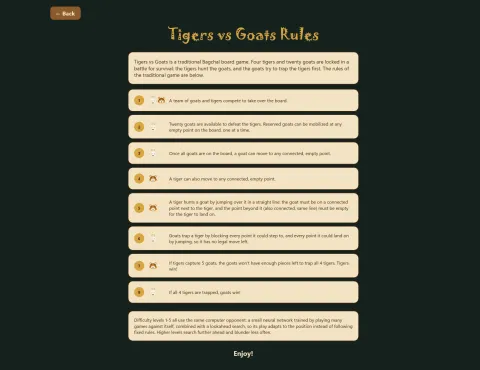
The rules are also in the game, as numbered cards on the Help page.
Once you know the moves, read the strategy tips for tigers and goats, or test yourself with the puzzles.
Common questions
Who moves first? The goats.
Can a goat capture a tiger? No. Goats win only by trapping the tigers.
Can a tiger capture more than one goat in a turn? No. Each turn is one step or one jump.
Can goats move before all twenty are on the board? No. Until then, every goat turn brings in a new goat.
Does a tiger have to capture when it can? No. Capturing is always optional.